

Introducing The Stoic Mind
Five Stoic techniques for managing anxiety, taught one at a time, starting in two weeks. Here's what to expect.


If you’ve been reading my newsletter for a while, you know that most of what I write links ancient Stoic philosophy to self-improvement and the challenges of modern living. What I haven’t done before is focus on five practical techniques and teach them to you directly, one at a time. That’s what we’ll be doing in this miniseries.
The Stoic Mind is based on a two-hour workshop that I developed, called Ancient Wisdom for Modern Anxiety. I’ve been studying the Stoics for three decades and teaching these techniques to therapy clients, workshop participants, and readers for most of that time. I’ve been impressed, again and again, by how well they work. They’re not important just because they’re ancient, but because they often anticipate modern evidence-based psychological techniques.
These five techniques have been used for two thousand years to cultivate calm and build lasting emotional resilience.
Before we get started, let me explain what this miniseries is all about. It’s not a series of history lessons or philosophy lectures. It’s a practical guide for putting Stoic philosophy to work in daily life.
Be like the promontory against which the waves continually break, but it stands firm and tames the fury of the water around it. — Marcus Aurelius, Meditations, 4.49
Consider the image below, which depicts a Stoic statue looking down at a storm. I like to think it’s not because he’s escaped it, but because he’s able to use his vantage point to calmly take it in.

That’s what these five techniques are designed to give you: the ability to stand steadily and see clearly through the chaos. And together they form a basic system. Each one builds on the last, and in the final lesson of the miniseries I’ll show you how all five fit together.
The Five Techniques
In each of the first five lessons, you’ll learn one of the five techniques. They include how to:
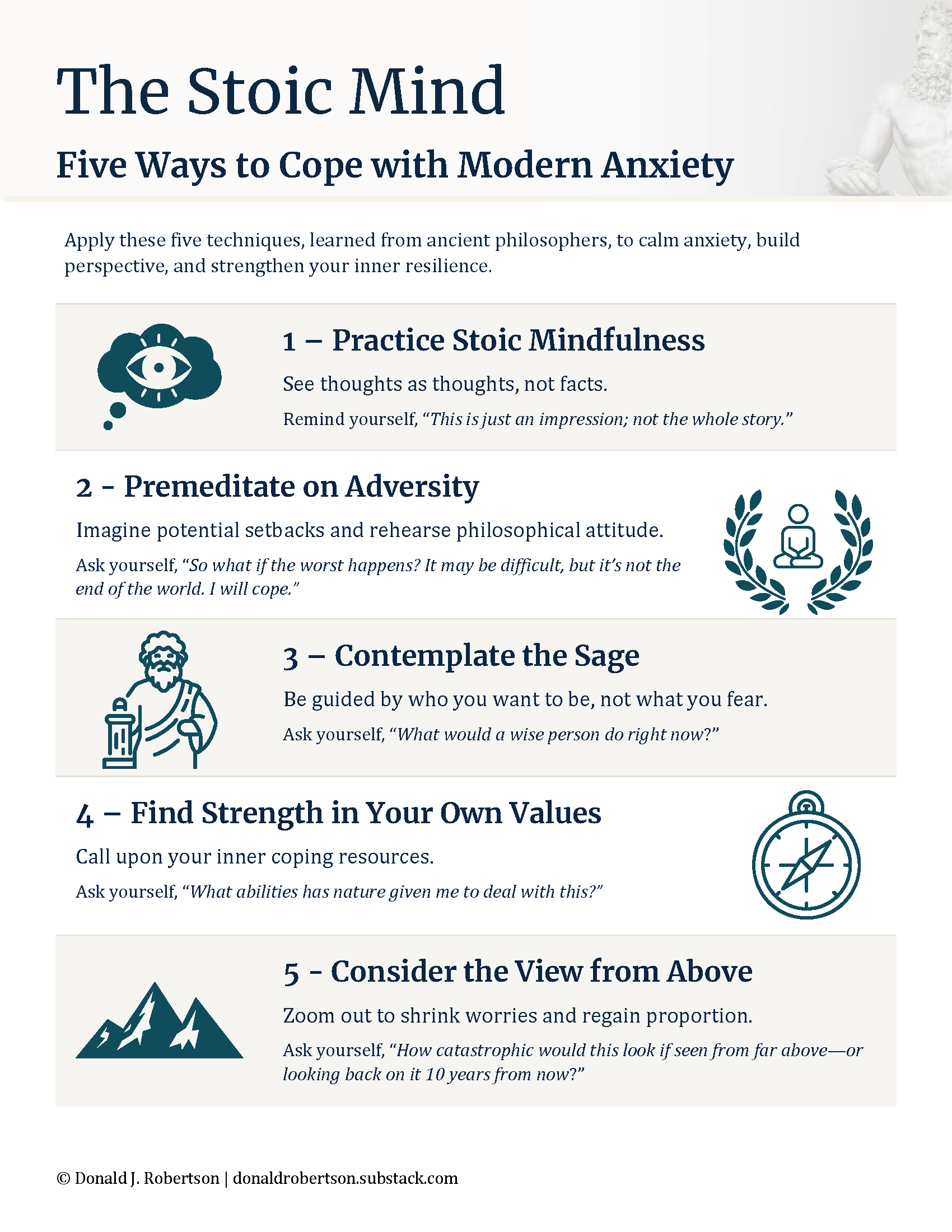
Detach from Anxious Thoughts (Stoic Mindfulness). This core technique from modern Cognitive-Behavioral Therapy (CBT), which was originally inspired by the Stoics, teaches you how to observe your anxious thoughts without getting entangled in them. You’ll gain the ability to create a space between you and your worries, giving you more control over your reactions.
Mentally Rehearse Coping (Premeditation of Adversity). Inoculate yourself against stress and build emotional resilience by calmly contemplating future challenges. This isn’t about worrying; it’s about progressively reducing your fear of the unknown and developing the confidence to handle whatever life throws at you.
Make Wise Decisions (Contemplation of the Sage). Discover a practical method for navigating difficult situations. This technique involves constructing an “inner mentor” based on the wisdom of figures like Socrates and Marcus Aurelius, and consulting them when you feel anxious or overwhelmed. It provides a clear framework for more rational and rewarding behaviour.
Find Strength in Your Own Values (Stoic Virtue Ethics). Come to understand how the Stoics found an unshakable source of confidence and tranquility not in external events, but in their own character and values. You’ll learn how to focus on what you can control, making you less vulnerable to the things you can’t.
Put Your Problems into Perspective. (The View From Above.) Discover a powerful Stoic meditation technique that helps you gain a “cosmic” vantage point. You’ll learn how to put your everyday worries into a much larger context, reducing their emotional impact and allowing you to see the bigger picture.
In the final lesson, we’ll bring all five techniques together as a system for managing anxiety. This lesson will be for paid subscribers only. (See more on that below.)
About This Miniseries
If you’re already a subscriber, you know what this newsletter’s about. The Stoic Mind sits inside it. It’s a six-lesson miniseries running within Stoicism: Philosophy as a Way of Life, publishing every second Tuesday.
Lessons 1 through 5 are for everyone. Each will teach you a complete technique, for free, with enough context and practical detail to actually use it and benefit from it. I don’t believe in withholding the substance from my readers.
What I’m offering paid subscribers within each lesson is something different, however: a deeper, guided experience of the same material. The paid portion of each lesson will contain an audio of me walking you through the technique, the way I do in my workshops. Many will also include a downloadable resource or practice tool, such as a worksheet or reference card. Think of the paid tier as the workshop version of The Stoic Mind.
Here’s a preview of what’s to come.
Download the Infographic
The infographic is an example of the kind of resource paid subscribers will receive throughout the series. While it’ll mean more after you’ve worked through the series, it’ll help you right now to see how the five techniques fit together.
Listen to the Audio
The audio’s my personal welcome to you. Consider it the opening of the workshop.
The paid portion of each lesson includes a guided audio recording, and many also include a practical template or worksheet. Lesson 6, the final lesson, is available to paid subscribers only and is a complete synthesis of all five techniques. In it, you’ll receive a longer coaching-style audio in which I guide you through using all five techniques together as a complete system.
Claim your Special Offer
To mark the launch of The Stoic Mind, new paid subscribers get 25% off for a limited time. Get full access by November 3, 2026, and you’ll unlock the full guided course, including audio practices, worksheets, reference cards, and the synthesis lesson.

If you’ve been thinking about upgrading to a paid subscription, this miniseries is the perfect opportunity to do it, because the audio and practice tools make a genuine difference to how well the techniques actually stick.
I’m looking forward to this. These are techniques I’ve used myself, taught to clients, and written about for years. Putting them together in this format, in the right order, with time to breathe between each one, feels like the right way to share them.
See you in two weeks.
Donald Robertson

Thank you, Donald! Really looking forward to this and grateful to continue learning from you.
Thanks