


Whenever you wish to know what should be avoided or pursued, look to the supreme good, the purpose of your whole life. — Seneca, Letters, 71.2
In this article, I’m going to begin by briefly explaining how traditional cost-benefit analysis (CBA) is used in therapy and coaching, particularly cognitive-behavioural therapy (CBT), and then explain how ancient Stoicism approached the same basic problem differently. The Stoic approach is, of course, more philosophical, and it seems to me to be more radical and insightful. I believe it may also have some important psychological advantages, as we shall see.
The conventional approach to cost-benefit analysis is definitely useful. The problem, I think, is that it usually begins weighing up the pros and cons of some course of action before asking a more fundamental question: What are our scales supposed to measure?
The condition and character of a non-philosopher is that he never expects benefit or harm from himself, but from external things. The condition and character of a philosopher [one who loves wisdom] is that he expects all benefit and harm from himself. — Epictetus, Enchiridion, 48
How do we define these terms? What do words such as “cost” and “benefit”, “pro” and “con”, “advantage” and “disadvantage”, “help” and “harm” actually mean? Something can, in fact, only be advantageous or disadvantageous in relation to a goal or value. If we don’t make that goal explicit, we risk simply assuming that the things our culture conventionally treats as desirable —such as money, status, pleasure, approval, etc.— are ends in themselves, that they are inherently helpful (benefits) and their opposites are harmful (costs).
Socrates, and the Stoics, thought about this very differently from most people today. Their solution was to challenge the standard by which we classify things as costs and benefits in the first place. They urge us to begin by identifying our fundamental goal in life (telos), and achieving that goal is how they define flourishing (eudaimonia). The famous Stoic slogan “living in agreement with Nature” alludes to the idea that our supreme goal can also be understood as flourishing by fulfilling our natural potential as rational and social beings.
For the Stoics, therefore, the goal of life is defined more specifically as a form of wisdom, from which the other cardinal virtues derive — justice (and kindness), temperance, and courage. Philosophy means the love of wisdom, or, you might say, treating wisdom as our highest good and the greatest virtue. The Stoics are emphatic that we should only call something truly “advantageous” or “disadvantageous” in relation to that goal. Stoic cost-benefit analysis would therefore weigh up pros and cons in relation to our highest good, and the source of flourishing, which they equate with wisdom and virtue. In this article, I’m going to suggest that, although many people today may broadly agree with Stoic ethics, they can also benefit from this approach even if they adopt a more flexible definition of the fundamental goal.

The Traditional Approach
Cost-benefit analysis, or weighing up pros and cons, is a familiar technique in modern psychotherapy and coaching. For example, it’s used in cognitive therapy of anxiety disorders to help clients evaluate the short- and long-term consequences of holding certain beliefs.
Cost–benefit analysis is a cognitive intervention that teaches clients to take a pragmatic approach by examining the immediate and long-term advantages and disadvantages of assuming exaggerated threat, or alternatively, of adopting a more realistic perspective. — Clark, D. & Beck, A.T., Cognitive Therapy of Anxiety Disorders, 2010
It can just as easily be applied to behaviour. A phobic client, for instance, might compare the pros and cons of avoiding a feared situation with those of confronting it through exposure therapy.
One of the most important insights that emerges from this method is that we often exaggerate the short-term benefits of our current behaviour and overlook its long-term costs. Avoidance, for example, genuinely can reduce anxiety for a little while. Unfortunately, persistent avoidance also tends to maintain anxiety and perpetuate the phobic disorder. In the long run, the behaviour gives us more or less the opposite of what we wanted. Psychologists once called this pattern the neurotic paradox: we continue doing something because of its immediate payoff even though it ultimately makes our problem worse.
The same method is often applied to mental activity and emotions. Worrying may seem to keep me prepared for danger. Self-criticism may seem to motivate me. Anger may seem to protect me from being pushed around. Cost-benefit analysis asks whether these apparent benefits are real, how long they last, and what hidden costs they may entail. Likewise, certain beliefs, especially those taking the form of rules, can be evaluated in a similar way. We can ask, for instance, what the advantages and disadvantages are of believing “Other people should respect me, because if they don’t they’re complete jerks!” There’s an important philosophical assumption hidden in this procedure, though.
As Seneca put it, there is no wind that is advantageous to you if you don’t know to which port you’re sailing.
Clark and Beck’s (2010) standard Cost-Benefit Form, for instance, asks clients to list the immediate and long-term “advantages” and “disadvantages” of a belief and then circle the ones that are “most important to you.” Crucially, it does not explicitly ask the client: Advantageous for what? In other words, what goal or value is being assumed? The client is asked to rank things that have already been classified as benefits or costs, without first being required to specify the standard according to which that classification was made. As Seneca put it, though, there is no wind that is advantageous to you if you don’t know to which port you’re sailing. How can you truly say whether something is a “pro” or “con” unless you first know what you’re trying to achieve?
That ambiguity is left unresolved in many approaches to CBT and coaching. However, one specific form of CBT, called problem-solving therapy (PST), which makes more extensive use of cost-benefit analysis, does encourage clients to explicitly identify their goal first. Its usual sequence is to define the problem, set a realistic goal, generate possible solutions, and then systematically evaluate the pros and cons of each solution. As Arthur Nezu explains, “effective solutions are those coping responses that not only achieve such goals, but also simultaneously maximize other positive consequences (i.e., benefits) and minimize other negative consequences (i.e., costs)”. Even in PST, however, the goal is usually defined as a relatively concrete desired outcome: resolve this conflict, change this situation, reduce the distress it causes, find a job, become more socially active, and so on.
Another cognitive-behavioural approach to have explicitly emphasized the role of personal goals is Rational Emotive Behaviour Therapy (REBT), developed by Albert Ellis in the mid 1950s. From the early 1980s onward, Ellis was explicitly teaching clients to identify their personal goals and defining rational beliefs partly by whether they helped people fulfill those goals or not. However, although Ellis’s conception of rationality was fundamentally goal-relative, techniques such as cost-benefit analysis did not always require clients to make the link to a specific personal goal explicit. Moreover, not unlike PST, REBT typically assumed those goals were specific external outcomes rather than character traits or qualities of action, resembling the Stoic virtues.
Acceptance and Commitment Therapy (ACT), a modern form of behaviour therapy, comes closer to the Stoic position. ACT therapists talk about workability: whether a thought or behaviour is actually helping someone move toward the sort of life they want and the values they have chosen. Russ Harris summarizes the basic question as:
Is what you’re doing working to give you the sort of life you want, in the long term?
ACT also distinguishes values, meaning ongoing qualities of action, such as being loving, courageous, or supportive, from goals that can simply be achieved and crossed off our list. That is much closer to the perspective I’m describing here, which derives from ancient virtue ethics. However, ACT usually applies this through questions about workability and valued direction rather than by systematically reconstructing a full cost-benefit analysis around those values.
The Need for Speed
There’s also a problem with doing a conventional cost-benefit analysis in the heat of the moment. It can easily become too laborious. If there are several possible courses of action and numerous immediate and long-term consequences to consider, the full procedure can take a while.
That’s fine when we’re reflecting beforehand or reviewing what happened afterwards. If I’m afraid of dogs, I can sit safely at home with a sheet of paper and examine the costs and benefits of avoiding them. During an actual encounter with a large dog in the park, however, I’m anxious, distracted, and short of time. I probably don’t have enough mental bandwidth to go through a detailed worksheet.
Therapists therefore often compress this sort of reasoning into much simpler questions:
“How’s this sort of avoidance working out for me?”
“Where’s running away from my fears getting me?”
“Is avoiding facing my fears helpful or harmful?”
“Could running away get me the opposite of what I want?”
Preparing ourselves, however, by reflecting systematically on cost-benefit analysis when we have time, and no distractions, makes these questions much easier to answer when we’re under stress.
These brief questions leave us with the same philosophical problem, though. Helping me to do what? Harming me in relation to what? Where am I actually trying to get? The Christian phrase quo vadis — where goest thou? — is used to highlight the need to understand what direction your life is going in.
This is why I think the Stoics offer a better perspective.
The Stoic Approach
For what shall it profit a man, if he shall gain the whole world, and lose his own psyche? — Mark, 8.36
Plato depicts Socrates discussing something surprisingly similar to cost-benefit analysis in the Protagoras. He describes an “art of measurement” (metretike techne), in which pleasures and pains are weighed against one another, although he also applies the method more generally to good and bad outcomes.
Socrates, nevertheless, seems reluctant to fully endorse this method. He thinks of it as how the majority of people might make decisions, if they were to reflect more carefully. In another of Plato’s dialogues, though, the Phaedo, Socrates appears to give the reason for his hesitation.
The exchange of one fear or pleasure or pain for another fear or pleasure or pain, which are measured like coins, the greater with the less, is not the exchange of virtue. O, my dear Simmias, is there not one true coin, for which all things ought to exchange?—and that is wisdom; and only in exchange for this, and in company with this, is anything truly bought or sold, whether courage or temperance or justice. — Plato, Phaedo
Pleasure and pain should not be the main currency we trade in throughout our lives because the “true coin” by which everything must be evaluated is wisdom.
The problem is not simply that we’ve assigned the wrong weight to money, pleasure, pain, or reputation. The problem is that we are weighing them against one another, as though they constitute the only standard of value in life. Socrates and the Stoics believed, though, that we should weigh all such external goods against our fundamental goal in life.
The Stoics certainly did not ignore consequences. Epictetus explicitly tells his students to consider what comes before an action and what follows from it. But the Stoics also insist that we have to distinguish ordinary outcomes from what genuinely benefits or harms us as human beings.
Marcus Aurelius makes this point very clearly:
If you find in human life anything better than justice, truth, moderation, courage, and, in a word, anything better than your own mind’s self-sufficiency when it enables you to act according to right reason and to accept what is assigned to you without your own choice—if, I say, you see anything better than this, turn to it with all your soul and enjoy what you have found to be best. [...]
It is not right that anything different in kind—such as popular praise, power, wealth, or sensual pleasure—should come into competition with the rational and social good. [...]
So simply and freely choose what is better, and hold to it. “But what is better is what is advantageous.” Well then, if it is advantageous to you as a rational being, hold to it; but if only as an animal, recognize it as such and guard your judgment without arrogance. Only make sure that you conduct the inquiry soundly. — Meditations, 3.6, trans. George Long, modified
“Advantageous to me in what way?”, is the crucial question. Something may benefit me merely as an animal: it may give me pleasure, warmth, food, physical security, or sexual gratification. Something else may benefit my reputation or bank balance. Marcus is saying that we must avoid assuming that these benefit us as rational and social human beings. In particular, what feels painful or unpleasant doesn’t necessarily harm my fundamental goal, and what feels pleasant doesn’t necessarily do me any good in that regard. Indeed, sometimes having the temperance to renounce certain pleasures or the courage to endure painful or uncomfortable sensations can be necessary in life if we want to flourish.
Notice also that Marcus says wealth, popularity, power, and pleasure are “different in kind” from the goal of flourishing as rational and social beings. He doesn’t merely put flourishing, or virtue, on one side of the scales and give it a very heavy weight, setting it against wealth, reputation, and so on. The Stoics don’t think these things belong on the same scale at all.
The very next passage continues to apply this principle:
Never regard anything as advantageous to yourself if it requires you to break your word, lose your self-respect, hate someone, become suspicious, curse others, act hypocritically, or desire anything that needs to be hidden behind walls and curtains. — Meditations, 3.7
Suppose lying would earn me an extra $20,000. A conventional first pass might list the money as a benefit and the risk of being caught as a cost. Marcus wants us to stop earlier. If obtaining the money requires dishonesty, in what sense is it genuinely “advantageous” to a rational and social human being? It may be the sort of thing most people value, as though by default, but, on reflection, how does it serve your fundamental goal in life?
Epictetus makes the same point with a much more down-to-earth example. Someone once stole his lamp. His response was that the thief had indeed acquired something but had paid an astonishingly high price for it:
For a lamp he became a thief, for a lamp he became untrustworthy, for a lamp he became like a wild beast. — Discourses, 1.29
The thief possesses the lamp. If our criterion is simply Who ended up with more property?, he has profited. Epictetus changes the criterion. What sort of person did he have to become in order to obtain it? He gained the lamp but lost part of himself in exchange, by sacrificing his own character.
This does not mean that Stoics regarded money, health, friendship, or reputation as completely irrelevant. They famously distinguished between “preferred” and “dispreferred” externals. You can think of these as typically advantageous. Money can be useful; illness can make some things much harder. The crucial point is that externals do not by themselves constitute wisdom or flourishing. Their value depends largely upon the use we make of them. This is why Epictetus defines wisdom as the “correct use of impressions” or, as we might put it, the correct use of our experiences. That way of looking at things changes cost-benefit analysis quite dramatically.
In conventional cost-benefit analysis, being criticized by your colleagues, for example, might appear in the “costs” column by default. But criticism can provide an excellent opportunity to practise wisdom, courage, and temperance. Receiving praise might, for most people, appear in the “benefits” column, although love of praise could damage my character if I become more vain, anxious, or dishonest.
The good and evil of the rational and social animal lie not in what it undergoes but in what it does; likewise, virtue and vice lie not in being acted upon but in action. —Meditations, 9.16
Ancient philosophy placed considerable emphasis on the importance of not equating appearance and reality. An opportunity that appears to be beneficial, may be harmful in reality, and vice versa. The classification of experiences as costs or benefits may therefore turn out to be less obvious than it initially seemed.
Stoic Cost-Benefit Analysis
The simplest way to adapt conventional cost-benefit analysis is simply to clarify the goal relative to which we are using the words cost and benefit.
Epictetus actually uses the metaphor of weighing things on a scale. Philosophy, he says, requires us first to discover a standard (kanōn), “just as in the case of weights we have discovered the balance.” When considering pleasure he says, “Bring it to the standard; put it in the balance.” His conclusion is that things can only be properly “judged and weighed” once we have prepared the standard by which we’re going to measure them. In other words, before we begin weighing supposed costs and benefits, we need to know what our fundamental goal is, if that’s the standard we are using to judge them.
For a Stoic, the ultimate goal is living wisely and virtuously, or fulfilling our nature as rational and social human beings. You don’t have to begin there, though. Most people cannot clearly state their fundamental goal in life. In that case, a perfectly reasonable provisional goal might be “understanding what my fundamental goal actually is”, or simply learning to live more wisely. In some cases, even “self-improvement” can serve as a good enough provisional goal, as long as it ends up being defined more carefully later.
Once you’ve chosen a course of action to evaluate, you can then proceed in two passes.
On the first pass, do an ordinary cost-benefit analysis. Write down whatever initially strikes you as an advantage or disadvantage of the action. Those are your current assumptions about value, and seeing them written down is useful.
On the second pass, revisit each item and ask how it actually relates to your fundamental goal. In some cases, the answer may appear paradoxical because what at first seemed like a harmful outcome may turn out to be an opportunity for us to help ourselves improve if we cope with it wisely.
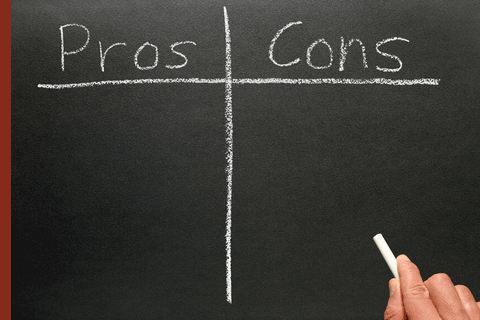
Suppose you’re considering accepting a promotion. On the first pass you might write:
Pros
increased salary
more status
Cons
longer working hours
more difficult people to manage
Now make your goal explicit. Let’s say you define it as some sort of wisdom. Would the extra income actually help you live more wisely? Perhaps it would give you greater freedom or allow you to support other people. Perhaps it would mainly finance things you don’t particularly need.
Are longer hours inherently a cost? Perhaps. Or perhaps accepting greater responsibility would provide useful opportunities to develop patience, courage, leadership, and self-discipline. Much depends upon how you use the situation.
What about the difficult people you’ll have to manage? They may be annoying, but that doesn’t settle their value relative to your fundamental goal. They might provide exactly the sort of challenge through which you become more tactful, patient, and fair.
Conversely, the promotion might genuinely draw you away from what matters most. The Stoic approach requires examining your reasons more carefully.
The same thing happens with social approval. Suppose speaking honestly but tactfully is likely to ruffle a few feathers. “People may think less of me” initially looks like a cost. But if fear of disapproval prevents you from acting courageously or honestly, avoiding that “cost” may actually interfere more seriously with your fundamental goal.
The important thing to realize is that the external event, the consequence of your action, does not arrive with a plus or minus sign already attached to it. What matters is the use you make of it.
Cicero reports that the Stoic Panaetius organized practical deliberation around a closely related distinction. We first ask whether an action is honourable or shameful, then whether it appears advantageous or disadvantageous, and finally what to do when apparent advantage seems to conflict with what is right. For the Stoics, the final conflict is ultimately illusory: something that requires us to act viciously cannot be genuinely advantageous to us in the fullest sense.
A more concise version of the two-pass method above would be simply to cut to the chase and ask, in one pass, what the costs and benefits of the action you’re evaluating are for your own character.
Rapid Stoic Evaluation
There is another advantage to this way of doing cost-benefit analysis. In my experience, a virtue-oriented approach lends itself much better to rapid coping under stress. Conventional cost-benefit analysis tends to make us project ourselves into the future and consider several possible consequences unfolding at different times. That can be extremely useful when we’re sitting quietly at home with a notebook. Under stress, and under time pressure, in the heat of the moment, it can be cumbersome, though.
Marcus Aurelius gives himself a much more concise instruction:
With each action ask yourself: “How does this stand with me? Will I come to regret it?” [...] What more am I looking for, if the present action is the work of a rational and social creature? — Meditations, 8.2
The question brings attention back to the present moment: What am I doing right now, and what sort of person am I being by doing it?
What am I making of my own mind right now? On every occasion I should ask myself this again and examine what is now going on in that part of me which they call the ruling faculty. What sort of mind do I have at this moment? — Meditations, 5.11
He goes on to ask himself whether he has the psyche of a child, a tyrant, a tame animal, or a wild beast. In short, Marcus was asking himself whether he was behaving wisely or unwisely, virtuously or viciously.
Suppose someone insults me at a party. Later, I can perform a detailed cost-benefit analysis of retaliating, remaining silent, confronting them calmly, making a joke, leaving, and so forth. In the moment, I need something quicker. I can simply ask: Would what I’m about to say be wise, just, courageous, and self-controlled?
That shifts my attention away from the insult and back toward the one thing over which I have considerably more control: my response to it.
Some useful rapid questions are:
Am I acting in accord with my core values?
Am I using my potential to live rationally?
Does this help me act with wisdom?
Am I acting with justice, fairness, and kindness?
Am I exhibiting courage and self-control?
Does this help me become the sort of person I want to be?
How could this become an opportunity to practise wisdom?
What does me more harm: my anger, or the thing I’m angry about?
You don’t need to run through all of them. The point is to find one question that works well enough to interrupt the habit, restore self-awareness, and improve your choices.
In the heat of the moment, under stress, it may be enough simply to ask yourself: “Does this serve my fundamental goal?” Or to borrow Marcus’ question: “Will I regret this?” — am I acting unwisely or going against my core values. Then a more detailed cost-benefit analysis, of the kind we discussed above, can come later.
Conclusion
There’s nothing wrong with weighing up pros and cons. The problem begins when we forget that the words pro and con, advantage and disadvantage, cost and benefit, already contain judgments about value. As Epictetus said, before weighing anything, we need to know what our scales are measuring. We need a standard against which to measure whether something is truly a cost or a benefit.
Conventional cost-benefit analysis, such as the CBT approach used by Beck, often leaves that standard unspecified. That risks encouraging us to default to the unreflective values taken for granted in our society — such as viewing wealth or reputation as ends in themselves. Problem-Solving Therapy improves on this by defining a concrete goal before weighing possible solutions. ACT goes further by explicitly asking whether our behaviour is workable in relation to our chosen values and the life we want to build.
The Stoics, however, pushed the question further still. They ask the underlying philosophical question. How are we defining “cost” and “benefit”? Ultimately, they evaluate the consequences of our actions in relation to the fundamental human goal of living wisely and virtuously. That dramatically shifts our perspective because whether something is truly an advantage or disadvantage, in that regard, clearly depends to a large extent on the use we make of our experience. The Stoic approach also seems more consistent because all decisions are ultimately referred back to the overarching philosophical-therapeutic goal of self-improvement and the attainment of flourishing.
One practical way to begin is simply to ask yourself, before acting, whether what you’re about to do serves your fundamental goal or helps you to improve your character. Later, when you have more time, you can revisit the decision and perform the more systematic two-pass analysis we discussed. If you want to practice, I’ve created an online worksheet using Google Forms that can be used for Stoic cost-benefit analysis.
The ancient Pythagorean practice of reviewing the day before sleep lends itself naturally to this. Ask yourself:
What did I do well?
What did I do badly?
What did I leave undone?
In other words, how did I use today’s experiences in relation to the person I am trying to become — and what could I do differently tomorrow?
That, I think, is the most important Stoic correction to conventional cost-benefit analysis. The things that happen to us are not simply costs and benefits waiting to be weighed in the balance. They are also opportunities to be used either wisely or unwisely.
I'm relatively new to Stoicism. Just finished the only book on Stoicism Ive read so far - your "How to think like a Roman Emperor". Really enjoyed it and feel like I learned alot. I've always made pro/con lists and have stuck my toes in CBT methods- like the book this article was also very clear & helpful for moving forward with applied Stoicism. Thanks!
Where do you think REBT would fall into this? Do you think it has some improvements over CBT? Does it still fall short of ACT?