


In this lesson, we’ll walk through what may be the most philosophical meditation found in ancient Stoicism, known today as the View from Above.
In this technique, you’ll practise looking upon your everyday worries from a cosmic vantage point, reducing their emotional impact and allowing you to see the bigger picture.
Of all the techniques I’ve learned from Stoicism, this one stood out because there are very few direct parallels to it in modern psychotherapy. So, it seemed fitting to save it for the last Stoic Mind lesson that is available to all subscribers, free and paid. Lesson 6, the final lesson, is available to paid subscribers only and will give you a complete synthesis of all five techniques and a downloadable summary of the worksheets and activities we’ve offered throughout the course.
The mind free from unhealthy passions is an acropolis. For a man possesses nothing more secure, into which he can fly for refuge and for the future be unconquerable. — Meditations, 8.48, trans. Long, adapted
For now, let’s dive into the View from Above, and how you can use it to put your problems into perspective.
This written lesson is free to read and share. Paid subscribers will also find a guided audio exercise and downloadable Journaling worksheet later in the lesson.
How I learned to love the View from Above
As we know, ancient Stoics had an extensive toolbox of therapy techniques. In my first book, The Philosophy of CBT, I listed about eighteen psychological strategies found in the ancient Stoic writings. Most of them had obvious parallels in modern psychotherapy, but one of their most important techniques was virtually non-existent.
Although I was intrigued with the concept, the fact that we weren’t practicing this technique in CBT made me wonder, “Hmm. Perhaps it’s no good?”
I sat with this thought for a short while. But then, while living in the UK, I was running a training school for psychotherapists. When I shared the technique with my students, their reaction helped to change my perspective. They didn’t think it sounded crazy, or no good. Quite the opposite: they thought it sounded like it would work, and they wanted to give it a go.
After walking through the technique together, we all had the same thought: “Why aren’t we doing this in CBT?”
What is the View from Above?
Marcus Aurelius compares the mind that has achieved apatheia through Stoic therapy, or freedom from unhealthy desires and emotions, to a high citadel.
I wondered what he meant by the term “citadel”, but it took me some time to investigate. When I finally checked the original Greek text, I realized the word he uses in that passage is acropolis. There were many acropolises in ancient Greece but the most famous then, as now, is the Athenian Acropolis.
The Acropolis was originally a hilltop fort that evolved into a temple complex dedicated to Athena, the patron goddess of Athens. From this high point in the city, you can look down upon the Agora, the city-centre and marketplace, where we believe Socrates was put on trial and executed.

Imagine, now, Athena looking out from the Acropolis to the Agora. Think of her contemplating the people below, rushing from one concern to another. Though the individual dramas might seem enormous to the people caught up in them, from Athena’s view, she can see how small each one is within the life of the city.
Yet, as she contemplates the fabric of the community below, she can also see the meaning in its activity. Each person is playing their part in the universe — be it wondering, worrying, celebrating, mourning, or embracing the different situations that unfold before them.
Throughout the Meditations, Marcus talks about how he regularly imagines himself looking down from high above on the world, as a sort of daily contemplative exercise.
Look down from above on the countless crowds of people and their endless activities, on their many journeys through storms and calm seas, and on the different lives of those who are born, live together, and die.
Think also of the lives people lived long ago, the lives of those who will come after you, and the lives now being lived in distant lands. Consider how many people have never even heard your name, how many will soon forget it, and how those who praise you today may soon turn to criticism.
Remember that neither being remembered after death, nor reputation, nor anything else of that kind has any real value. — Meditations, 9.30, trans. Long, adapted
He wasn’t alone in this kind of perspective shifting. The twentieth-century French scholar Pierre Hadot found examples of this concept scattered throughout ancient literature, in different schools of philosophy, and in the writings of poets.
Hadot called this The View from Above. Through his research, we learn that the View from Above can take different forms:
Sometimes it takes a mythological form, where we imagine looking down on events from high above, like Zeus looking down on the whole world from Mount Olympus – or Athena looking down on Athens from the Acropolis. In a sense, it’s an attempt to imagine adopting the perspective of God.
Other times, it takes a cosmological form, where we imagine the whole of space and time, as if from the perspective not of a mythological god like Zeus but of the more metaphysical god of the philosophers.
In both versions, the technique is the same. As we rise above our usual perspective, we imagine seeing things from far above. In that moment, the world around us becomes larger, more interconnected, and easier to appreciate.
Perhaps most importantly, the View from Above gives us a new perspective on problems that seemed so large and important from the ground.
Now, let’s look at a related meditation technique. All subscribers have access to the instructions and written exercise below. Paid subscribers will have additional access to a special 14-minute guided audio meditation, where I’ll personally guide them through the whole View from Above technique from start to finish.
Let’s begin.
Activity: Time Projection
5-minute activity
Activity Instructions
First, find a comfortable position, seated or lying down. Close your eyes and take a few moments to settle into your posture.
Now, do the following:
Think of a possible future event you’re anxious about. Imagine that it has already happened and you’re dealing with it now.
You may worry, for example, about losing a job, failing an exam, experiencing a relationship breakup. Suppose the problem has already happened, and you’re dealing with it right now.
Now imagine that you’re coping wisely with the situation.
You don’t have to imagine doing so perfectly, just getting through things to the best of your ability, coping emotionally and practically with the problem, by focusing on the aspects under your control.Imagine looking back on the event from five or ten years in the future.
Suppose you get through it and continue to cope reasonably well with the consequences over time.Would it still seem as catastrophic, in hindsight?
Do you still evaluate it in exactly the same way or in a somewhat different way?
This may sound like an odd question, but if you would view it as an unfortunate setback but not a massive catastrophe ten years from now, why shouldn’t you feel that way about it today?
In general, events seem more catastrophic prospectively, when we worry about them happening in the future. They typically seem less severe retrospectively, when we look back on them. That’s partly because we underestimate our ability to cope and move on. People worry about losing a job or the end of a relationship. Decades later, looking back, even if these still seem like highly unfortunate setbacks, they probably no longer feel catastrophic.
Activity Reflection
This technique, known as “time projection”, is often used in CBT to help with decatastrophizing. It views problems within a longer timeframe. Typically, when people worry they go over and over the worst moments of an anticipated problem, as if putting them under a magnifying glass. Imagining looking back on events from the future expands the temporal horizon, and helps us to gain perspective in a healthy way. The ancient Stoics often expanded their perspective on problems either temporally or spatially, and it’s possible to combine both at the same time.
In their theory of emotions and psychotherapy, the ancient Stoics talk about the psyche expanding or contracting.
They talk about how the wise person has megalopsychia, which literally means having a “big soul” — think mega and psyche. We get the English word magnanimity from the Latin equivalent, magnanimitas — think magnus and animus. That’s probably why they believed they should expand their mind by imagining the whole world seen from above, or even imagine the whole of space and time.
When someone is distressed or anxious, the Stoics believed their soul does the opposite and shrinks. While that may sound odd at first, I think they intuitively grasped something that has interesting parallels in modern psychological research.
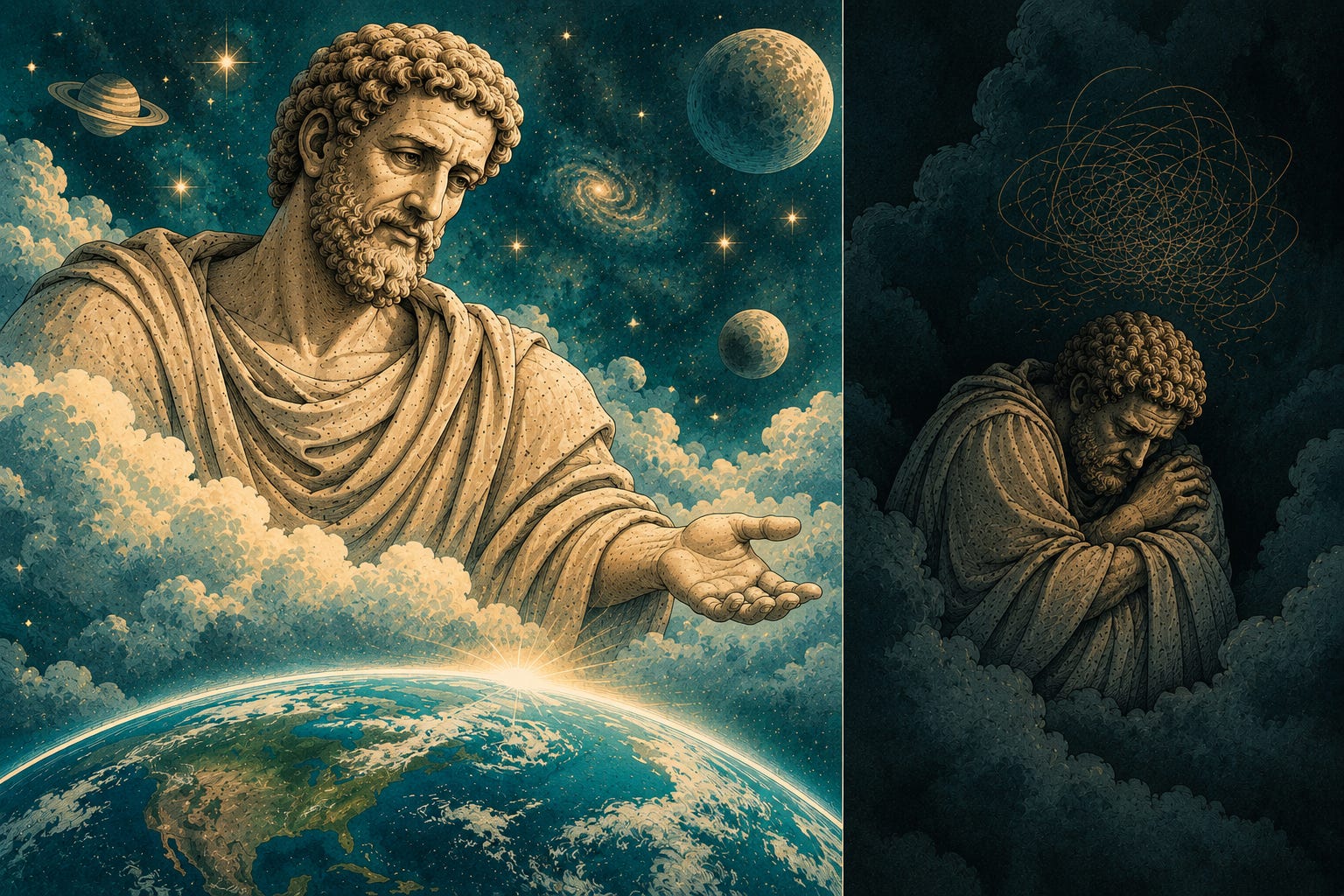
When we’re anxious, we often remain on the lookout for potential threats, sometimes to the point of hypervigilance. The scope of our attention tends to narrow, forgetting everything else and concentrating on the source of the problem or the perceived signs of danger. If you’re an animal being chased by a predator, that’s necessary for survival. However, as a human, living in the age of the internet, it can be quite unhelpful, especially if it goes on for too long.
When we’re anxious, we often focus on the worst part of a situation. When we narrow our attention, we engage in selective thinking, which means we often overlook potential signs of safety. We put the bad stuff under a magnifying glass, amplify our distress, or ignore aspects of the bigger picture that might change the way we feel about our problems.
By training yourself to look at things from a wider perspective, you can potentially counteract your narrowing attention and selective thinking, allowing you to recognize aspects of the situation you may have overlooked, and to remember that even intense feelings can change over time, and eventually pass.
I believe this is what Marcus Aurelius meant by the high citadel. To rise above the immediate drama doesn’t mean detaching from life, but rather, gaining enough distance to see it clearly.
Join our Discussion
What changes for you when you view your problems from a much larger perspective? Does it matter more whether you expand your point of view spatially or temporally?
Does something that has been troubling you feel different when viewed from above or from the future? What did this help you recognize about what you can and cannot control?
Please share your thoughts in the comments, including anything you noticed during the exercise. You can use a hypothetical example or omit any personal details. And to help foster social learning, please take a moment, if you can, to respond to the comments of others.
If you’re a paid subscriber, you can continue below with a guided audio walkthrough of the View from Above technique, followed by a downloadable Journaling worksheet.
To access the exclusive content below, subscribe to this newsletter. We’re offering a 25% discount, for a limited period, for new paid subscribers.
Get worksheets, audio recordings, and other bonus materials, from this and other lessons, when you upgrade.
