


Most of the coaching clients that I meet, at some point, feel that they need help to bridge the gap between intellectual insight and emotional insight. Cognitive-behavioural therapy (CBT) and Stoic philosophy can both appear, at first, to be more about our thinking than our feelings — but that would be a mistake. Each recognizes that it takes practice to translate words, and thoughts, into more concrete emotional change. One of the main limitations of reading self-help books, by contrast, is that it often leads to the arid intellectualization of problems. If you’re not careful, it ends up being all talk and no action.
CBT emphasizes combining cognitive and behavioural strategies in order to break through this barrier to change. Behavioural experiments such as repeatedly facing your fears or refraining from problematic habits are virtually essential if you want to really change emotions. In fact, it’s often best to view your thoughts, actions, and feelings more holistically, as different aspects of a single unified experience. The division between them is very convenient but somewhat artificial in practice. Your goal is to improve as a human being, by thinking, acting and feeling differently.
Albert Ellis’ Rational Emotive Behaviour Therapy (REBT) is the type of CBT which has the most in common with and was most influenced by Stoic philosophy. It’s what I tend to use in coaching. As the name implies, Ellis was emphatic that his therapy aimed to change our beliefs, emotions, and behaviours.
You think-feel-behave and your thoughts influence your feelings and behaviors, your feelings influence your thoughts and behaviors, and your behaviors influence your thoughts and your feelings. All three are integrated and we falsely see them as separate. — Ellis, How to Stubbornly Refuse to Make Yourself Miserable
Knowing something in your head and really feeling it in your heart and gut are not the same thing. When the process of change unites our thoughts, actions, and feelings, it’s more likely to lead to lasting improvement.
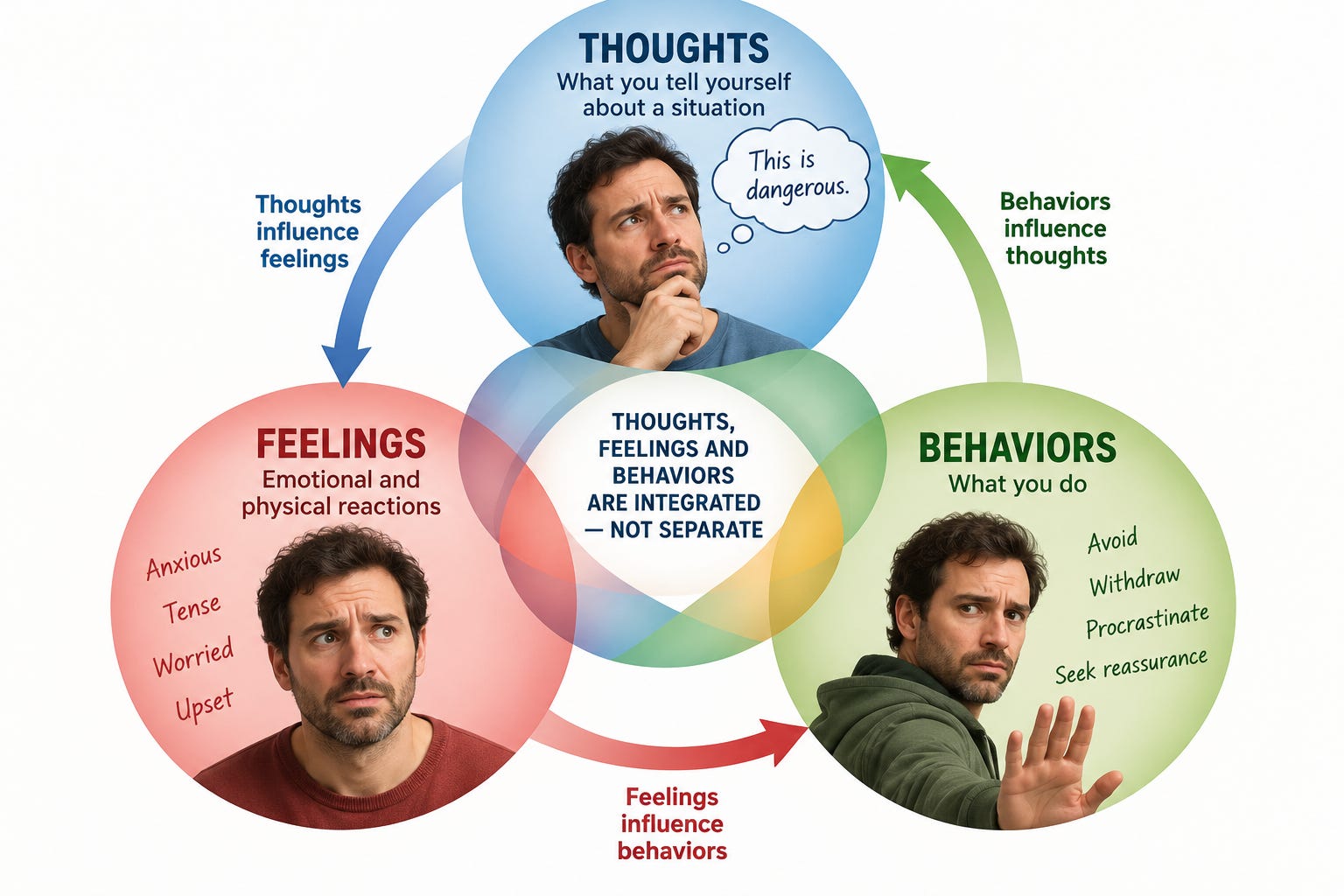
In this article, I’ll be describing one of the signature “emotive-evocative” techniques used in REBT to confront strong emotions and challenge the beliefs behind them. It’s known as Rational Emotive Imagery (REI) and was designed to help bridge the divide between intellectual and emotional insight.
The Historical Roots
Psychiatrist Maxie C. Maultsby Jr. introduced the technique in a 1971 article called “Rational Emotive Imagery”. It was originally more of a cognitive rehearsal exercise, which involved visualizing a stressful event while silently reciting rational beliefs to calm yourself down. For example, someone might imagine his boss criticizing his work unjustly while he forcefully tells himself a rational coping statement prepared beforehand, such as “I would prefer it if people treat me fairly, but there’s no law of the universe that says they must. I don’t like it, but I can stand it.”
In Maultsby’s version, it wasn’t emphasized that the client should take time to fully experience the initial emotional distress. Ellis, however, made REI more visceral. He encouraged clients to stare the worst-case scenario dead in the face, let their body churn with unhealthy feelings, and then force those old feelings to shift, at a gut level, by replacing them with a healthy emotion. In an article on the subject, written in 1971, Ellis described this step as follows:
To do this, really work at changing your spontaneous disturbed Negative feeling (C1) to a prescribed healthy Negative feeling (C2)—such as sorrow, disappointment, regret, frustration, irritation or displeasure. How? By telling yourself—strongly and repetitively—a sensible rational Belief (rB) or coping statement. — Ellis, ‘Rational Emotive Imagery’, Rational Living
Ellis described REI in slightly different ways in different texts. For this self-help version you will get the best results by understanding this cognitive mechanism beforehand and trying to identify your own irrational beliefs.

The ABC Model
Ellis introduced a simple “ABC model” to conceptualize clients’ problems: activation, beliefs, consequences.
A: The Activating Event: Triggers your emotional distress or behavioural problems. That is often a specific situation in which you hear or see things that upset you, but it may also include “inferences,” or ideas, such as your assumptions about what other people are thinking or predictions about what’s going to happen in the future.
B: Your Irrational Beliefs: Primarily your rigid demands (must, should, need to, have to, etc.) but also extreme beliefs derived from them such as “awfulizing”, ”low frustration tolerance”, and ”self-damning” or “other-damning”. For example, “People must respect me, or they are total jerks!”, “I must succeed at work; otherwise it means I am a worthless failure!”, “I have to control my feelings; otherwise it’s awful and unbearable!”, and so on.
C: Emotional and Behavioural Consequences: The response that you, initially, experience as if it were caused by the activating event (A) but which is, in reality, caused by your irrational beliefs (B).
Prof. Windy Dryden, the leading proponent of REBT in the UK, describes REI using the ABC model as follows:
One of the most important stages in any kind of CBT practice is to help the client move from intellectual to emotional insight, and one of the steps for achieving this ‘head to gut’ shift in REBT is to immediately follow the disputation stage with rational emotive imagery (REI), before then proceeding to behavioural homework assignments. The preferred procedure for REI is to first ask the client to bring to mind the specific adversity and the unhealthy negative emotion at C (e.g. anxiety), then secondly to switch to the corresponding healthy alternative emotion (e.g. healthy concern) without changing the adverse situation at A. The ideal outcome is where the client is able to achieve this change by replacing the irrational beliefs with the rational alternatives at B. When the client struggles to achieve this, by for example, changing the A instead of the B, they can be coached to bring to mind the RBs [rational beliefs] separately and then together. — Dryden, The Distinctive Features of Rational Emotive Behavior Therapy
Ellis sometimes prescribed repeating this exercise as homework, for a few minutes each day, up to thirty days in a row. I would say that rating your progress each time, or at least every seven days or so, can be helpful. You should target the same problem each time, until you’re confident you’ve really changed how you feel about it.
Keep imagining the worst-case, your activating event or trigger, and allow yourself to feel any genuine distress that still arises so that you can practice your rational coping statements under stress. Recent research on psychotherapy confirms that we often benefit more reliably when we tolerate anxiety and other unpleasant feelings, for a while, and prove to ourselves that we can endure and cope with them.
Rational Emotive Imagery, if repetitively done, thus becomes a useful REBT tool to train yourself more thoroughly to feel healthy, instead of unhealthy, negative emotions when bad Activating Events enter your life. By consistently using it, you can change both your thinking and feeling habits and make yourself not only less disturbed, but eventually less disturbable. — Ellis, ‘Rational Emotive Imagery’, Rational Living
It’s important to emphasize three ways you can cheat in this exercise because you’re only likely to achieve significant results if you avoid these shortcuts:
Do not cheat yourself by changing the situation that you’re imagining, which Ellis calls the Activating Event (A). Focus on the worst-case scenario and keep it constant. Going from imagining everyone criticizing you to imagining everyone praising you might seem like you’re doing “positive visualization” but it isn’t really going to achieve anything; it’s just another form of avoidance.
Do not cheat by telling yourself that you’re mistaken about some of the supposed predications, assumptions, interpretations, or “inferences”, as Ellis calls them, which upset you. Don’t go from imagining that your wife hates you to telling yourself that maybe you’re wrong and she actually loves you. Again, that sort of “positive thinking” is just subtle avoidance of the problem.
Don’t use distraction techniques or try to control your feelings by force, something we call “experiential avoidance” today. Don’t try to relax your uncomfortable feelings away. Sit with them for a moment, and change them by working on the underlying attitude that actually causes them.
This may seem pretty direct, but most people, it turns out, can change their emotions, and it usually only takes a few minutes.
The Goal: Healthy vs. Unhealthy Negative Emotions
In short, REI is about rational thinking, not positive thinking. The goal is not to feel irrationally happy or numbly indifferent in the face of a real misfortune or when contemplating a threatening future possibility. The goal in REBT is to replace what Ellis called Unhealthy Negative Emotions (UNEs) with Healthy Negative Emotions (HNEs). These emotions are more rational, less rigid and extreme, and more constructive.
If you keep practicing Rational Emotive Imagery (REI) for a few minutes every day for several weeks, you will reach a point where whenever you think of an event about which you would normally make yourself angry, you will tend automatically to feel disappointed and annoyed rather than enraged. — Ellis, ‘Rational Emotive Imagery’, Rational Living
Here are a few common examples:
Rage, Anger, or Hatred → Rational Annoyance or Irritation
Panic or Anxiety → Rational Concern
Depression or Self-Hatred → Rational Sorrow, Sadness, or Disappointment
Shame or Guilt → Rational Regret or Remorse
Unhealthy emotions stem from rigid demands (”This must not happen!”), which typically paralyze you. Healthy negative emotions stem from strong preferences (”I hate this, but I can stand it”), which motivate you to act constructively.
Look out for Secondary Disturbances
When asked to evoke an unhealthy emotion, some people respond by getting upset about the feeling. For instance, you may feel ashamed of your anger. Disturbing yourself about your disturbance will only paralyze your efforts to change. Unconditionally accept yourself. Do not awfulize, demand instant success, or put yourself down for experiencing your primary emotional upset or for struggling to execute an exercise perfectly. Accept yourself as a fallible and imperfect human being who can sometimes get upset.
The 5-Minute REI Protocol
To make Rational Emotive Imagery practical and easy to follow, do not try to discover your beliefs out of thin air while sitting in acute emotional turmoil. Before closing your eyes, take thirty seconds to write down your target adversity (A), the unhealthy negative emotion you want to change (C), the dogmatic demand driving it (B), and a flexible rational alternative (E).
Once your rational statement is clear, set a timer for five minutes, sit in a quiet spot, close your eyes, and go through these four steps:
1. Vividly Imagine the Adversity
Pick a scenario that reliably triggers you. Do not sanitize it or water it down. If you dread public speaking, picture blank stares, stammering, and dead silence. If you fear rejection, picture the person looking you in the eye and walking away. Make it concrete; face your biggest triggers or the worst-case scenario. Keep the Activating Event (A) constant throughout.
2. Sit with the Unhealthy Negative Emotion (~1 Minute)
Look directly at the scene and allow your habitual, unhealthy emotional reaction to emerge naturally. Do not breathe it away, reach for a calming mantra, or distract yourself. Feel the physical knot in your throat, the clenched jaw, or the urge to flee. Notice the physical sensations that tell you you’re being triggered, and prove to yourself that you can sit with them for at least a minute or so without running away. Notice the underlying rigid demand driving the pain. For instance, “I must not make mistakes; otherwise it proves I am incompetent,” or “They must treat me fairly!”, and so on.
3. Shift the Feeling by Asserting Your Rational Belief (~2 to 3 Minutes)
Keep exactly the same scenario in your mind’s eye—keep the critic frowning, keep the audience silent—but actively push your emotional state to shift from an unhealthy negative emotion to a healthy negative emotion.
Do not do this by brute force suppression, distraction, or relaxation. Instead, shift the feeling by forcefully and repetitively asserting your pre-planned rational coping philosophy (E) right in the middle of the emotional storm:
Surrender the Demand: Tell yourself that you may prefer to get what you want, but there’s no law of the universe that says that you must.
Anti-Awfulizing & Frustration Tolerance: Tell yourself that you don’t like how it feels, but you will survive, you can stand it, and it isn’t the end of the world.
Unconditional Self-Acceptance: Tell yourself that failing or being criticized never makes you a worthless person.
Stay with the image until you feel the emotional needle move: irrational panic turns into rational concern, rage into firm annoyance, and crushing shame into rational regret. Get your feelings back in perspective, in other words.
4. Confirm the Rational Alternative
Open your eyes and confirm the belief that produced the shift. Ask yourself: “What did I just tell myself to make that shift happen?” For instance, check that you abandoned “This absolutely must not happen!” and replaced it with “I strongly dislike this, but I can stand it, and it doesn’t make me a worthless person.” Write your new rational belief down.
When they have changed their feeling to a healthy negative one, they are then to keep practicing, preferably at least once a day, for the next thirty days, until they train themselves to automatically or unconsciously experience the healthy negative feeling whenever they imagine this Adversity or when it actually happens. — Ellis, Overcoming Resistance
Once you have identified the cognitive key, daily practice becomes more streamlined: summon the worst-case adversity, let the initial distress come up for a minute or so, and then firmly rehearse your rational coping philosophy, under stress, until the healthy emotion takes over.
Practice, practice, practice that belief. Push yourself to think, act, and feel in accord with that belief, as if you really believed it 100% at a gut level.
Donald, the distinction between understanding an idea and actually feeling it is extremely important to me. I can agree with a Stoic principle all morning long and still forget it the moment someone tests my patience. Rehearsal makes the philosophy something we practice, not just admire. Great read, thanks.
"REI is about rational thinking, not positive thinking." That line clears up so much. Your rule about not changing the A reminds me of the old image of a rope in the dark: a man freezes at a coiled shape on the path. Telling himself "maybe it isn't there" does nothing. What frees him is seeing what he was telling himself about it. Ellis goes one step braver, though: even if it really is a snake, the panic was still optional, and the concern is enough.