


Like most people, I was initially drawn to Stoicism because it promised emotional resilience, but I soon learned that it offered something much deeper: a whole philosophy of life. As you no doubt remember from earlier lessons, Stoicism is fundamentally a virtue ethic. Perhaps surprisingly, a very similar perspective has become extremely important over the past few decades in modern evidence-based psychotherapy. In particular, one of the leading treatments for clinical depression, known as Behavioural Activation, focuses on identifying your core values and scheduling daily activities that align with them.
The written lesson is free to read and share. Paid subscribers will also find a 19-minute guided audio exercise and downloadable Character Compass worksheet later in the lesson.
Behavioural Activation
The Stoics teach us to accept uncomfortable feelings in order to learn to endure and cope with them. Many people live lives where their behaviour completely revolves around avoiding pain, anxiety, or discomfort, and seeking out pleasure, often as a form of distraction. And it turns out that depressed people tend to do that more than average. When we allow anxiety to run our lives, we have to sacrifice something, which often means abandoning activities that we potentially find more meaningful and fulfilling. Modern therapy for depression involves reducing avoidance behaviour and increasing activities that honour our core values. Similar techniques that clarify our values and align our actions with them, have been found to be helpful in treating anxiety and other problems.
What do you mean by core values?
In these lessons, core values refer to character traits or strengths, like the virtues of the ancient Stoics. For example:
Wisdom
Justice
Integrity
Kindness
Courage
Endurance
Temperance, and more…
They’re qualities of character, expressed in our actions and the way we live. For instance, we can go to work on a task courageously, or exhibit wisdom in the way we speak to our children, and so on.
A lot of traditional therapy and self-help assumed that its goal was to reduce anxiety or eliminate other unpleasant feelings. Many people share that assumption. While that might seem like common sense, there’s a problem. Research shows that people who think anxiety is really bad and desperately want to get rid of it often end up becoming even more anxious over time. We tie ourselves in knots trying to avoid feeling anxious because trying too hard to control the involuntary aspects of anxiety can make them even worse. We end up with the opposite of what we really want. Consider the state of the striving-to-be-Stoic statue in the scenario below.
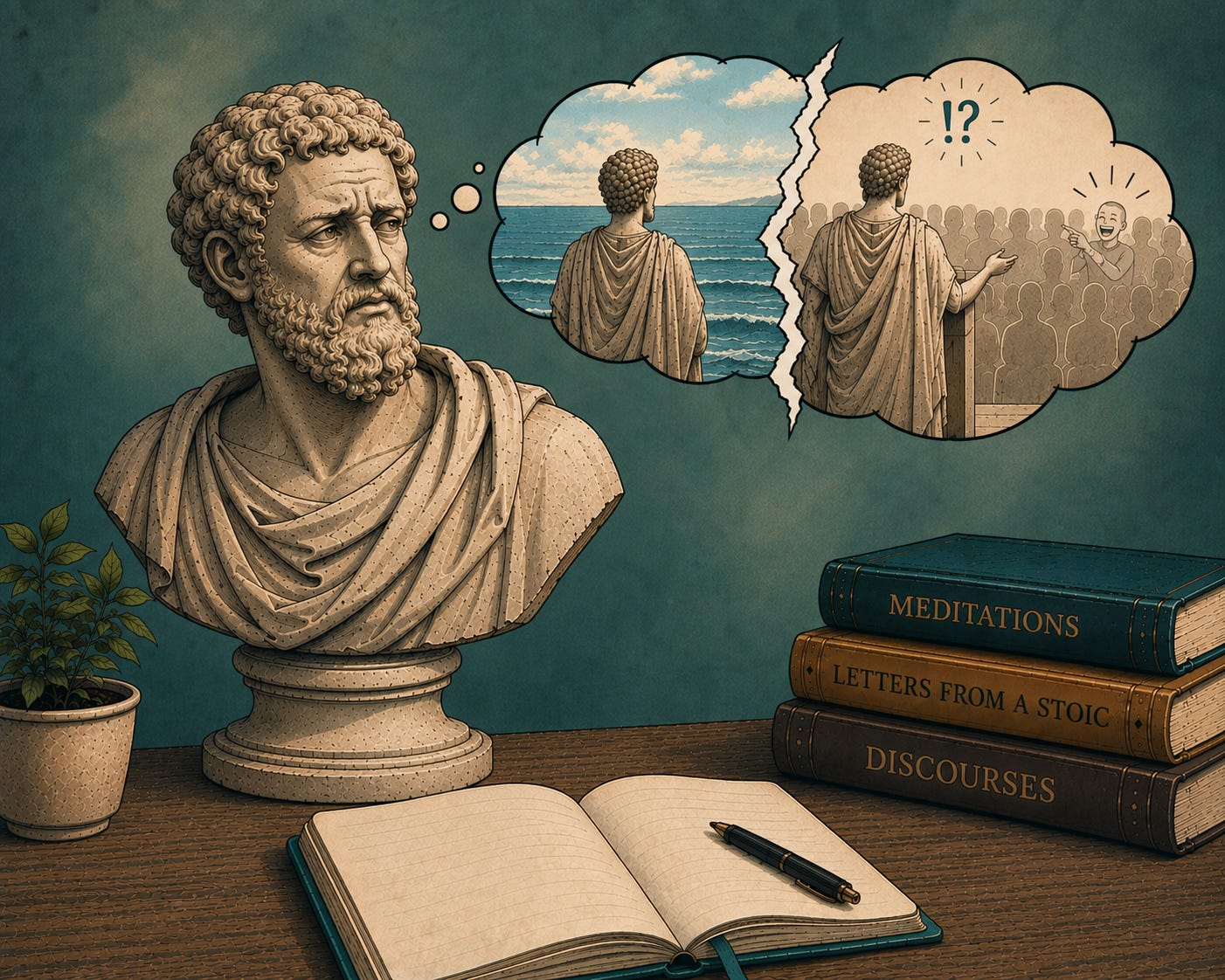
We all know that trying too hard can often backfire. Trying too hard to fall asleep can keep you awake; trying too hard to relax can make you tense; trying too hard to be funny at a party can make you awkward and self-conscious; and trying too hard to avoid feeling anxious can make you even more anxious. In fact, psychologists measure a trait called “anxiety sensitivity,” basically intolerance of anxiety, which is correlated statistically with more severe worry and anxiety, including panic attacks — and, to some extent, it is even associated with depression.
Learning to fear anxiety may often make anxiety worse.
People with severe anxiety symptoms tend to have higher than normal ratings of anxiety sensitivity. They are more likely to interpret the experience of anxiety itself as threatening. In fact, researchers have found that ratings of anxiety sensitivity account for nearly 20% of the variation, statistically, between people’s ratings of anxiety severity. That suggests that learning to fear anxiety may often make anxiety worse.
For example, people who suffer from panic attacks often worry that because their heart is beating very fast they’re going to collapse or have a heart attack. So they see anxiety as dangerous and feel a desperate need to avoid or control the symptoms. Of course, if you believe anxiety is dangerous, you’re going to have anxiety about your anxiety — which is second-order anxiety, and it can rapidly spiral out of control. If you regarded the anxious feelings as harmless, however, you might eventually get used to them, allowing them to calm down naturally.
Likewise, with social anxiety, people are often ashamed of looking anxious. They worry about things like, “What will other people think if they see my hands shaking?” So they try really hard to conceal how anxious they feel. But the more people worry about looking anxious, the more anxious they become. It’s a vicious cycle. If they didn’t care about looking anxious, they’d feel much less anxious. Given enough time, they may then get over their initial nervousness about how they come across in social situations.
Second-Order Anxiety
Second-order anxiety, or anxiety about anxiety, can prevent anxiety from running its course naturally and wearing off over time. I like to call it “anxiety squared” or “anxiety BOGOF” (buy one, get one free) — it’s a double-helping of anxiety.
The Anxiety Paradox
If you want to get rid of anxiety, it’s better to accept it. But to accept it means you don’t actually want to get rid of it anymore… so what’s the goal?
What should your goal be, if not to control, reduce, or avoid your anxiety? Well, maybe the anxiety itself is less of a problem than the avoidance that it causes. Perhaps rather than allowing anxiety to run your life and railroad you into avoidance, a healthier goal should be to live more in accord with your true values despite feeling anxious. Perhaps the number one priority shouldn’t be “no anxiety” but instead to have an attitude that says, “I’m taking my life back, and I’m not going to let anxiety stop me!” We can view anxiety as an obstacle that blocks us from living in accord with our values. Or, we can view it, paradoxically, as an opportunity to strengthen our commitment to those values. Interestingly, when we stop fighting against anxiety, accept it, and focus instead on our values, our anxiety often diminishes anyway.
When we are more preoccupied with avoiding unpleasant feelings than flourishing and living in accord with our values, we get ourselves turned around. If we want to live in accord with our values, we’re often going to have to do so despite feeling anxious and uncomfortable. In fact, even if you were the least anxious person in the world, you would inevitably still feel some anxiety at some point in your life. You cannot completely avoid feeling anxious, except perhaps by having brain surgery. So coping with anxiety is essential to courage. And, as C.S. Lewis said, “Courage is not simply one of the virtues, but the form of every virtue at the testing point.”
If you want to be a compassionate person, for example, you’ll need, at some point, to endure anxiety in order to stay true to your compassion. If you want to be creative, you’ll need, one day, to tolerate anxiety in order to be fully creative. Otherwise, avoidance of anxiety will undermine your commitment to your values. And interestingly, remaining committed to your values can help you to experience anxiety differently. Let’s test that out right now.
Activity: Align Actions to Values
5-minute activity
Activity Instructions
Take at least five minutes and do the following:
Close your eyes, and focus on your breathing, just as you have done in previous activities. Don’t deliberately change your breathing.
Bring a mildly anxiety-provoking situation to mind.
It might be the same situation you’ve used for earlier lessons, or it might be a different one. See what you see; hear what you hear; feel what you feel. As before, actively accept your anxious feelings, and patiently allow them to come and go freely. Sit with them for a while, and let go of any effort to fight against them or control them. (Are you going to put your life on hold just because your heart’s beating a bit faster than normal and your hands are shaking? No, you can resume being your true self, and acting in accord with your true values. You don’t need to wait for your anxiety to go away; nobody is stopping you from changing your behaviour.)
Turn your attention to your core values, meaning the type of person you want to be in this situation, and how you want to behave. Consider:
Do you want to have wisdom here?
Do you want to show kindness to yourself or others?
Do you want to have courage or resilience?
Do you want to behave with awareness and composure?
Picture accepting the presence of those uncomfortable thoughts and feelings, so that you can behave the way you want to behave in this situation, in accord with your values. Remember that you can accept that a thought has occurred, without necessarily buying into it. Stop waiting for the thoughts and feelings to go away; practise being yourself despite the feelings. Act contrary to what your anxiety is telling you to do. Those feelings don’t need to be an obstacle. Set yourself free and prove that your behaviour doesn’t need to be driven by feelings of anxiety.
You’re capable of moving your arms and legs and speaking, even though your heart’s beating a bit faster than normal. Accept the feelings and focus instead on acting in accord with your core values. Tell yourself, “Even though I may feel anxious, I’m going to do this anyway; I’m doing this for the sake of my core values.”
Name those values (wisdom, compassion, courage, or whatever they are) and dedicate your actions to them.
Slowly open your eyes and bring your attention back to the room around you. But continue to act in accord with your values, and clarify through your actions what they mean.
Activity Reflection
The ancient Stoics believed that we should challenge the belief that unpleasant feelings are harmful or unbearable and that we must avoid them, complain about them, or express them in other self-defeating ways. Instead, they believed that we can align our actions with wisdom and virtue, in order to flourish as human beings. Pain and other unpleasant feelings are classed as “dispreferred indifferents” in Stoic philosophy, meaning that they’re not evaluated as inherently “bad” or “harmful”.
The very act of accepting anxiety is a form of resilience, or the virtue of courage. As Seneca says, it would be impossible to exhibit courage without experiencing something akin to anxiety.
Anxiety thus becomes an opportunity for us to behave courageously, rather than an obstacle that prevents us from doing so.
No longer talk at all about the kind of man that a good man ought to be, but be such. — Marcus Aurelius, Meditations 10.16
Join our Discussion
What’s one situation you tend to worry about or avoid? Suppose you had faced similar situations countless times already and increased your tolerance of the associated discomfort until your attitude became: “I may not like this but I can cope with how it feels.” How might becoming more tolerant of anxiety and discomfort help you in the long run? How could you potentially gain something by facing situations that you tend to avoid? In what way might you be able to approach them as opportunities for self-improvement or the exercise of character traits you value?
Please share your thoughts in the comments, including anything you noticed during the exercise. You can use a hypothetical example or omit any personal details. And to help foster social learning, please take a moment, if you can, to respond to the comments of others.
If you’re a paid subscriber, you can continue below with a guided exploration of ways in which anxiety can shape your character over time, followed by a downloadable Character Compass worksheet.
To access the exclusive content below, subscribe to this newsletter. We’re offering a 25% discount, for a limited period, for new paid subscribers.
Get worksheets, audio recordings, and other bonus materials, from this and other lessons, when you upgrade.
