


In Lesson 1, we began by learning to take a step back from anxious thoughts. Rather than struggling with every thought that enters the mind, you practised distinguishing between thoughts that arise automatically and the way you voluntarily respond to them. We also used a meditation technique, called Leaves on the Stream, to learn to accept automatic thoughts and let go of them.
In Lesson 2, we went a step further and deliberately brought a feared situation to mind and practised relaxing into the anxiety. The aim was to discover, through experience, that uncomfortable feelings can be tolerated and that we can mentally rehearse coping with difficult situations, through emotional acceptance, rather than avoiding them.
There’s a progression here. First, we learn not to become completely entangled in every anxious thought. Then we learn that we can tolerate the feelings associated with anxiety. Finally, we can begin examining more closely the judgments that give those feelings much of their force.
When we worry about the future, after all, our minds seldom tell us merely that something undesirable might happen. We typically add another layer of meaning: That would be awful. I couldn’t stand it. It would be a disaster.
Consider the image below. The striving-to-be-Stoic statue has a number of fears and worries, including public speaking. They imagine giving a speech to an audience that’s not very responsive. “That would be a disaster,” they think.
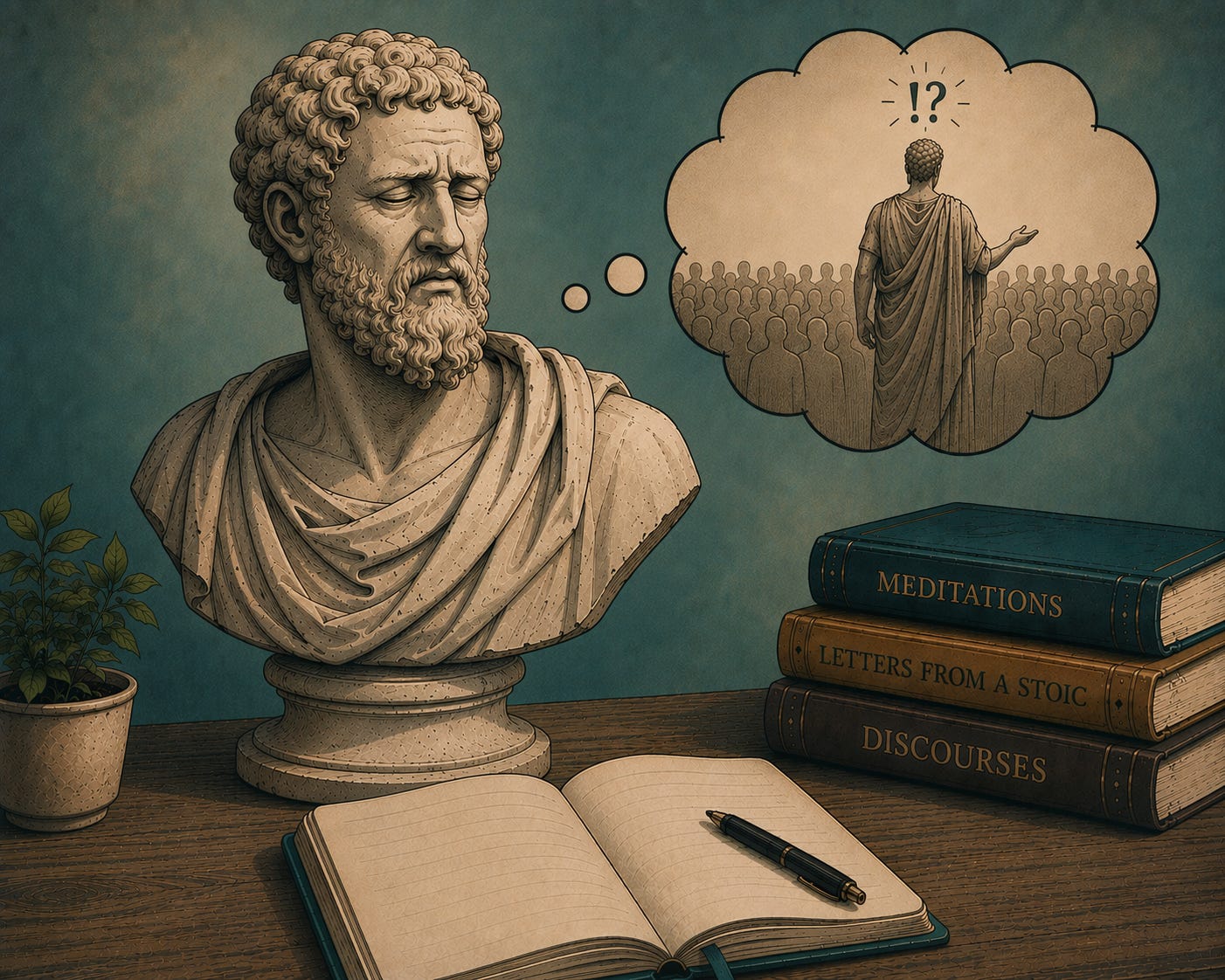
These evaluations can begin to feel like objective descriptions of the situation itself. Yet being “awful” or “catastrophic” is not something we can literally see, hear, or touch in an event. It is a subjective evaluation that our mind makes about what is happening. The problem isn’t that it’s false. Rather it’s that it’s a value judgment masquerading as a statement of fact.
That distinction is central to Stoicism. Epictetus famously says that people are disturbed not simply by events but by their judgments about them. He also told his students that when they have a distressing thought they should speak to it and say: “You are just an impression and not entirely the thing you claim to represent.” Thoughts are not facts — they may appear to represent facts accurately but they’re never the whole story. Cognitive therapists make a similar distinction when they use the word catastrophizing: we are describing something the mind is doing to an event, i.e., interpreting and evaluating it in a particular way.
This doesn’t mean pretending that bad things are really good, or convincing ourselves that everything will turn out fine. It means becoming less rigid about the way we evaluate difficult events and remembering that our first automatic appraisal is not necessarily the only reasonable perspective available to us.
What we’ve already discovered
The initial responses to the exercises in the first two lessons are encouraging. Here’s how the first wave of participants voted in those two polls.
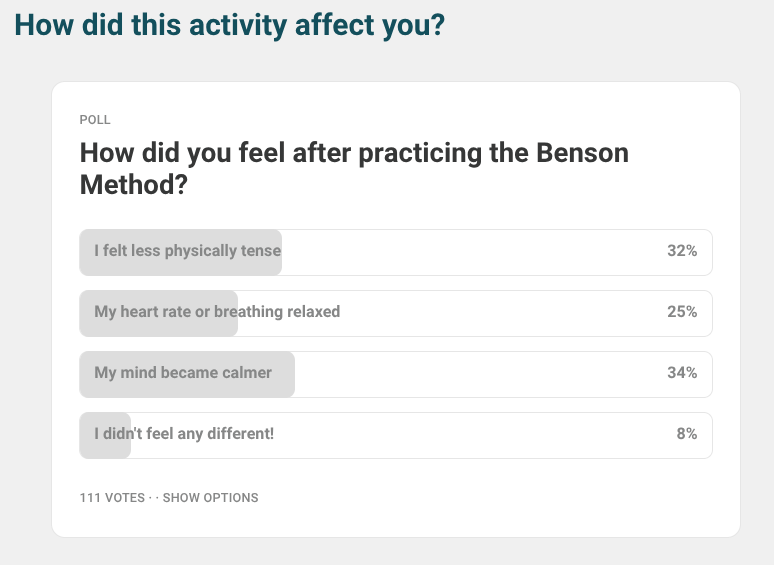
After practising the Benson Method in Lesson 1, 92% of respondents reported some noticeable change: 34% said their mind became calmer, 32% felt less physically tense, and 25% noticed their heart rate or breathing relaxed. Only 8% reported no difference.
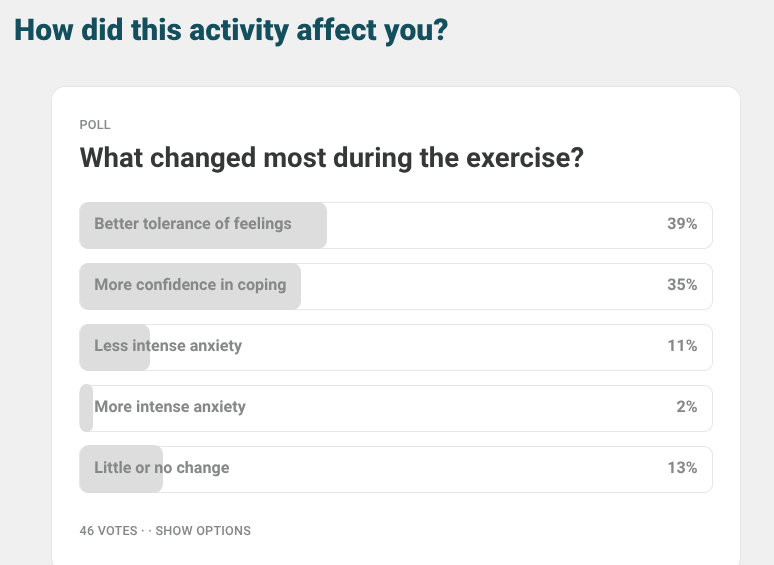
The Lesson 2 results are interesting for a different reason. Only 11% said that the main change was simply less intense anxiety — that’s natural because it wasn’t the goal of this particular exercise but it can be a side effect. By contrast, 39% reported better tolerance of their feelings and another 35% reported greater confidence in their ability to cope. Anxiety tolerance, and emotional coping, were exactly what we were practising. A further 13% reported little or no change, while 2% experienced more intense anxiety. So 85% of respondents reported one of these improvements after just a few minutes.
The aim of these exercises is not simply to make anxiety disappear but to face it and learn to cope with it. With practice, we can become more willing to experience uncomfortable feelings and more confident that we can deal with the situations that trigger them.
So far, you’ve practised stepping back from automatic thoughts, changing your physiological response to anxiety, facing a feared situation in your imagination, and rehearsing your ability to tolerate and cope with the feelings that arise.
In this bonus lesson, we’re going to build on those skills by focusing more closely on another part of the process: how you evaluate the situations that make you anxious.
Bonus Resources
As a bonus, I’m making both the guided audio exercise and the accompanying worksheet available to everyone.
The audio will let you practise the technique experientially, while the worksheet gives you a more deliberate way of applying the same principles to a particular worry or worst-case scenario.
Audio Exercise: Consciousness of Evaluating
The following guided exercise will help you bring a manageable worry to mind and then notice the way you automatically evaluate the feared outcome.
Rather than trying to convince yourself that the situation would be harmless or that everything will work out well, you’ll practise distinguishing the facts of the situation from your evaluation of those facts.
You’ll then explore several different perspectives on the same event: how another reasonable person might view it, how you might see it while actually coping with it, and how your perspective might change much later when looking back.
The aim is not to discover the one perfectly rational interpretation. It is to loosen the kind of tunnel vision that can make our first catastrophic appraisal seem like the only possible one. Prepare yourself by choosing a worry to work on — an anticipated outcome that you typically catastrophize.
When you’re ready, press play. When the recording ends, take a moment to reflect.
Once the recording has ended, pause and review what changed before moving on. Bring the same feared situation to mind again and notice whether your experience of it has changed.
You might ask yourself: Does it seem just as unquestionably awful and catastrophic as it did before, or is there now a little more room for uncertainty, ambiguity, or flexibility in the way I anticipate and evaluate things?
Activity Reflection
Now, let’s reflect.
How did this exercise affect you?
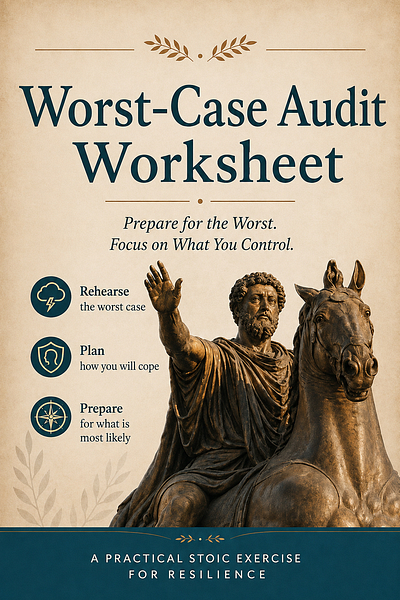
Worst-Case Audit Worksheet
The guided exercise helped you practise looking at a feared situation from several different perspectives. Now the Worst-Case Audit worksheet will help you tackle catastrophizing more deliberately, focusing on the appraisal of probability.
You’ll begin by identifying the situation you’re facing and spelling out the worst outcome you’re afraid might happen — your biggest fear about it. Rather than stopping there, however, you’ll then mentally rehearse how you could cope if the worst actually occurred—both emotionally and practically—while focusing especially on what remains within your control.
Next, you’ll consider the best outcome you could realistically hope for if you responded wisely and resiliently, and what you can do now to increase the chances of that happening. You’ll then compare this with the most likely outcome, asking how close you could realistically come to the best-case scenario and what preparation might help. Finally, you’ll reflect on how your thinking has changed and decide what you want to do next.
Choose whichever format suits you best:
complete the worksheet online and receive a copy of your responses by email; or
download the printable version to complete digitally or offline.
Once you’ve completed the worksheet, bring the original situation to mind again.
Notice whether you’re quite as certain that your first appraisal was the only reasonable way of viewing it. You do not need to feel dramatically calmer. Even a small shift from “This simply is a catastrophe” to “Right now, I’m evaluating this as catastrophic” is significant.
That subtle cognitive shift can create room for other ways of responding.
Looking forward…
Anxiety naturally narrows our attention. When we anticipate something threatening, we can become fixated on the worst moment of the worst possible outcome, while overlooking everything else: our ability to respond, the support available to us, what happens next, how other people might interpret the event, and how our own perspective may change with time.
The Stoic alternative is not to insist that nothing bad can happen. It is to become more conscious of the judgments we add to events and more flexible about the perspectives from which we view them.
If you have one takeaway from this lesson, I hope it’s this: when your mind tells you, “This will be a catastrophe,” try hearing instead, “Right now, I’m evaluating this as catastrophic.”
You may ultimately decide that the situation really would be extremely serious. But once you recognize the appraisal as an appraisal rather than simply confusing it with the facts, you’ve created some psychological distance from it.
And that gives you more freedom to ask a very Stoic question: Given the situation as it actually is, what would it look like to respond to it wisely?
Discussion Question
Please share your comments below in response to this question and, if possible, reply to the comments posted by other participants.
Which of these three tendencies catches you most often when you’re worried?
Focusing too much on the worst-case scenario
Underestimating how well you could cope
Overlooking the most likely outcome
You can simply comment 1, 2, or 3 or share a recent example and what helped you regain perspective. If someone else’s answer resonates, reply to let them know.
To access additional exclusive content like what you see in this bonus lesson, subscribe to this newsletter. We’re offering a 25% discount, for a limited period, for new paid subscribers.
Thanks for reading Stoicism: Philosophy as a Way of Life. The written lesson is free to share. If you know someone who might find it useful, please restack it or send them the link.
How to Cope Wisely with Anxiety

Imagine you’re catching up with a friend or family member over coffee, and they start telling you about something that’s really bothering them. They’re frustrated, upset, and going over all the reasons they can’t seem to move past it.
There is something very concrete in this exercise that strikes me as philosophically important.
Take the example of public speaking. The room remains silent, a few faces seem closed, the heart begins to race. Then, almost immediately, comes the conclusion: this is going to be a disaster.
But where, exactly, is the disaster?
It is not in the room, nor in the faces, nor even in the beating of the heart. It appears in the meaning we give to what is happening. And your exercise seems particularly interesting to me because it creates precisely a space between the two.
A further question then arises. Why do those silent faces mean disaster to me, when to someone else they might mean concentration, indifference, or simply tiredness?
Perhaps our judgment no more comes from nowhere than our anxiety does. It too has a history. Our past experiences, expectations, fears, habits, and encounters have already helped shape the lens through which the situation appears to us.
This may be where Spinoza could quietly extend Epictetus. It would no longer be enough simply to distinguish the event from the judgment we make about it. It would also become interesting to investigate the causes of that judgment.
And this is what I particularly appreciate in the movement toward the worst-case scenario. It is not about telling ourselves that everything will be fine. The worst may happen. The anxiety may remain. But gradually, we stop confusing what we experience with what is.
Perhaps this is a rather quiet form of freedom: not deciding on command what we are going to feel, but understanding what affects us well enough that our first impression does not necessarily become our final verdict.
This leaves me with a question for you, Mr Robertson. Once we have learned to question an automatic judgment, should we not also ask what caused this particular judgment to arise in us in the first place? And how far, in your view, can this search for causes become part of the exercise itself?
Moriarty Benson
It starts with 1 - catastrophizing but then 2 - underestimating coping ability and 3 - not recognizing the most likely outcome, are locked and loaded. I found deliberately working through these stages in advance was particularly helpful. In the past I have tried to avoid thinking about this situation, chastising myself for ruminating on an event that has yet to occur. The structured approach is very different to rumination and I feel better prepared.