


Imagine you’re catching up with a friend or family member over coffee, and they start telling you about something that’s really bothering them. They’re frustrated, upset, and going over all the reasons they can’t seem to move past it.
As you listen, a little voice in your head might think, “Oh, come on… you’re not dealing with this very well!” You might even think, “Why don’t they just stop dwelling so much on the negatives?” or “Surely they can see that they’re making this harder for themselves?”
When you’re one step removed from a problem, self-defeating behaviour can seem quite apparent, and potential solutions may become more obvious. When you’re the one experiencing the problem, however, that same clarity can be much harder to find.
The good news is this:
The techniques we’ll practice today will help you become better at understanding your own problems, and more importantly, seeing the solutions more clearly.
The written lesson is free to read and share. Paid subscribers will also find a 23-minute guided audio exercise, a Stoic Modelling Worksheet, and a printable Coping Model Reference Guide later in the lesson.
As it turns out, you’re wiser than you realize
At the University of Waterloo, Professor Igor Grossman runs a lab doing research on wisdom, and his studies have shown that people can be significantly wiser when solving other people’s problems than when trying to solve their own.
Ancient philosophers were also well aware that we are, unfortunately, biased in many ways that interfere with our ability to solve our own problems. When asked what the most difficult thing was in life, the presocratic philosopher Thales of Miletus reputedly said: “To know oneself.” When asked what the easiest thing is he replied: “To advise another person.”
Marcus Aurelius’ court physician, Galen, wrote about this phenomenon. Galen said that because love is blind, self-love often blinds us to our own flaws. He quoted one of Aesop’s fables that says everyone is born with two sacks hanging around their neck. Before our eyes is a large sack, which we see wherever we go, containing everyone else’s flaws. However, a smaller sack hangs behind our neck. We don’t see it ourselves, according to Aesop, but it’s obvious to everyone else. It contains our own flaws.
Because it’s easy to see the flaws of others, it can also be easy to imagine how they might overcome them and improve. The Stoics, for instance, believed that we can better understand wisdom and resilience by imagining how a wiser person might react in the difficult situations we’re facing. For example, Epictetus advised his students to ask themselves what Socrates or Zeno would do in the scenarios they were struggling with themselves.
When you are about to meet somebody, in particular when it is one of those men who are held in very high esteem, propose to yourself the question, ‘What would Socrates or Zeno have done under these circumstances?’ - Enchiridion, 33
He did this with an understanding that his students could model their own behaviour after the strategies they imagined their sage or wise person would use. In other words, we can often unlock a greater capacity for wisdom, by looking at our problems from a different perspective.
Building an Inner Sage
Let’s pause for a minute here, to think about who your “inner sage” might be. Sure, you can choose to imagine how the great Stoics would react in any given situation. But who else might you consider an expert, as it relates to your own life experience? Can you think of other people, real or fictional, who have the qualities and traits you want to emulate in your own life?

Making a list of your ideal qualities and virtues isn’t easy for everyone. Some people struggle to articulate the list of traits they admire. However, even those people who are unclear about their values often have no problem telling you about the things, or people, they find annoying! Why is that?
The truth is that many people, especially when under stress, find it easier to express disapproval than admiration for others. Politicians, celebrities, and other public figures, are easy targets. These people can be described as negative role models — they show us what not to be. But if you can’t stand politicians or celebrities who you think are corrupt or dishonest, doesn’t that imply that you must value integrity and honesty?
As you think about it, you’ll notice something interesting:
Your dislikes can reveal your values.
So ask yourself: What do you actually dislike most about the characters of other people? What do you wish they were like instead? Could you praise someone who exemplified the opposite traits? If you hate cowards, does that not imply that you admire bravery? If lazy people infuriate you, doesn’t that suggest that you probably value industriousness — or at least that you should? It’s important to look for those positive values, and bring them to the surface, because you will naturally emulate the traits you focus upon. Although it’s easier to ruminate about the weaknesses and failings of others, that doesn’t give your brain good content for modelling. How could you do better than them? Constructing a positive alternative to the qualities we dislike in others, and emulating those good qualities, can be described as counter-modelling.
Take a few moments now to build your inner sage. Start by imagining both the things you like and dislike about the character of others. As you do, take notice of the qualities and traits you’d look for in your own sage or mentor.
You may have to look hard to hunt down glimmers of virtue in others but by studying people who have the qualities you admire, you can learn how to become a better person yourself, in your own eyes.
Now that you’ve started sculpting this wise and resilient character, ask yourself:
In the rest of this lesson, I’ll show you some techniques you can use to consult with, and learn from, your inner sage. As you apply them, you’ll probably notice new or different values that you want to add to the list of virtues you admire. That’s okay! Rome wasn’t built in a day and your inner mentor may require patient work. You can shape them, and yourself, over time.
Consulting with Your Inner Sage
Now that you’ve put together a vision of what a wise, resilient person looks like to you, let’s start learning from them. We’ll do this using a technique called modelling, or emulation.
There are two types of modelling:
Mastery modelling and
Coping modelling
Mastery modelling basically means emulating people who are perfect, or at least who perform the task confidently and successfully, without any visible difficulty.
For instance, if you have social anxiety you might be tempted to look for examples of the world’s greatest public speakers and try to be like them. Or, if you fear flying, you may be tempted to model your behaviour after the most seasoned pilot.
Unfortunately, research on this topic has highlighted a problem, which is that mastery modelling can backfire. By comparing yourself to someone you feel is already perfect, in some regard, you may find it difficult to visualize any of the steps that you need to take in order to make progress, and it can also result in you comparing yourself negatively to them — it sometimes makes progress feel impossible.
We can solve this problem by using our second type of modelling, which is called Coping modelling. This is when you look at people who are struggling, but overcoming setbacks. In other words, it’s more useful to study how people make progress than to study people who no longer need to do so. Many anxious people suffer from perfectionism, or rigid high-standards, and may rely too much on mastery modelling, but this often helps maintain their anxiety.
Thinking back to our earlier example of a fear of flying:
If you are using Mastery modelling, you may imagine the seasoned pilot boarding the plane and entering the cockpit without feeling nervous at all. Good for them, but it may be hard for you to emulate this in your own situation!
Using Coping modelling, you can more easily imagine the anxious flyer getting on a plane and taking off, looking a bit nervous, but doing it anyway, and coping with their feelings. Instead of picturing mastery, or perfection, therefore, try adjusting your model to imagine an anxious flier who is learning to deal with it wisely and resiliently, one step at a time.
If you have anxiety, and it feels difficult to control, it’s going to be more helpful to learn from someone who also has anxiety but copes well with the feelings, and behaves in accord with their values despite feeling nervous, rather than trying to be like someone who doesn’t seem to feel any anxiety at all. That could lead you to try to suppress your anxiety, deny it, or pretend it doesn’t exist, which we know usually does more harm than good.
Mastery modelling can still be useful, as an aspirational goal. It’s more like the destination, whereas coping is the journey. For the remainder of this lesson we’re going to focus on this journey, especially the initial steps you need to take to begin making progress. The Stoic Sage was not free from involuntary first movements of fear or distress. Although free from irrational passions in the strict Stoic sense, the Sage could still experience what later Stoics called propatheiai: automatic bodily and emotional reactions that arise before voluntary judgment.
The Sage is still an expert in coping: these reactions occur, but he responds to them exceptionally wisely. In a sense, therefore, he is somewhere between a mastery and coping model. So I prefer to think of the Stoic Sage not as a model of mastery but more as an expert in coping. He has achieved the maximum progress toward wisdom possible for a human, but he still has a fallible human nature, and experiences the propatheiai or involuntary urges and feelings of anxiety, etc. So he must cope with them, but he does so exceptionally well.
Coping modelling is especially beneficial because it can not only relieve anxiety, but also enable us to make wiser decisions under pressure. After imagining an anxious flyer getting on a plane, taking off, and then coping with turbulence, for example, you might be better equipped to deal with turbulence in the moment yourself.
Now, when you encounter turbulence while flying, instead of going into panic mode and catastrophizing as you have in the past (“This plane is definitely going down!”), you may be able to instead decide to look at the turbulence as a normal part of flying. (“While I really hate turbulence, it’s to be expected when flying.”) First, ask yourself: How might someone cope badly or unwisely with your problem? Then ask: How might someone cope well or cope wisely with it? What can you learn from those who cope better than others?
Coping modelling and consulting your inner sage can help you to make these sorts of decisions. Let’s try it out.
Activity: Coping Modelling
Let’s try this out in a 5-minute activity.
Epictetus famously said everything has two handles: a good handle and a broken handle. You can carry a burden if you firmly grasp the good handle, but not if you try to take hold of it by the broken one.
You can expand this logic to thinking about how you approach problems. If something is difficult or painful, you can “pick it up” by focusing on what is within your control, or you can grab the wrong handle, by focusing on what isn’t.

If you find yourself saying things like “I must not feel this way, it’s unbearable!”, or “This is awful and I can’t stand it”, you’re picking up your anxiety by the broken handle.
If you say things like “I don’t like these feelings but I can tolerate them; I can cope, if I take things one step at a time, and it’ll get easier with practice”, you’re reframing the situation and focusing on coping with your anxious feelings, like you did in the Imaginal Exposure activity we practised in Lesson 2. In other words, you’ve decided to use the handle that works.
We know from research that people who cope well often say things to themselves like:
“Stay calm—just take it one step at a time.”
“These feelings are uncomfortable, but they’re harmless.”
“Focus on what I need to do right now—and accept the feelings.”
“Notice my breathing… stay with it for a while… these feelings will pass.”
“I can handle this; I’ve gotten through things like this before.”
“I’m coping well. Keep going. You’re doing well.”
They’re coaching themselves through the problem. This technique is sometimes called writing a coping plan or a coping script.
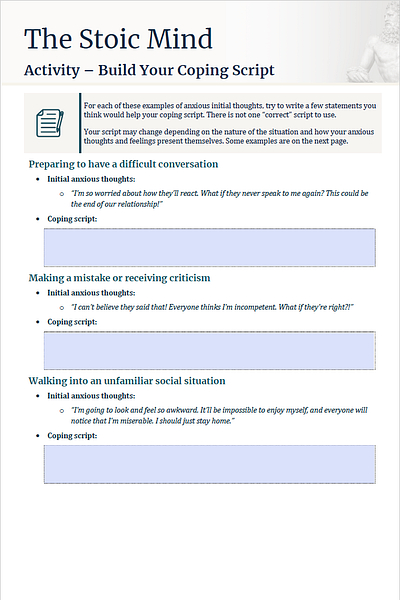
Now, let’s put these pieces together in our Coping Modelling activity.
Activity Instructions
Do the following:
Close your eyes, and focus on your breathing, just as you did in previous lessons. Don’t deliberately change your breathing.
Bring a mildly anxiety-provoking situation to mind. However, instead of imagining yourself in the situation, imagine some version of your inner sage in the same situation — not emotionless but an expert in coping with his emotions. In this activity imagine your sage still feels some anxiety and discomfort, although you imagine them behaving as wisely and resiliently as possible. Give yourself an example of someone coping exceptionally well with the problems you’re facing.
Imagine what that wise, resilient person would do. Say you have a fear of public speaking. For this activity, you’d watch your sage preparing for their speech while dealing with anticipatory anxiety, but remaining in the situation. What would they say and do if coping exceptionally well with the initial anxiety?
Now, go through the scenario again. Instead of just imagining what they’d do, imagine you can read their mind, and hear what they’re saying inside their head in order to deal with their anxiety. If you need to, use the bulleted phrases and the Build Your Coping Script Activity worksheet linked above to help build a coping script in your mind.
Repeat, repeat, repeat. Take a couple of minutes to replay the scenario 2-3 more times, each time paying attention to your coping model. Focus on what you can learn from their example.
If they can do it, you can do it. This time, picture yourself as if you’re observing yourself from the outside, but imagine you’re thinking aloud. Watch yourself deal with the situation, feeling anxious, but coping progressively better with the anxiety each time. Imagine yourself accepting the unpleasant feelings but acting in accord with your values. Remind yourself that you’ve made the decision to stay and observe your feelings, and as you do, see yourself becoming more skilled and confident at dealing with the situation, and tolerating your anxiety better, each time. Imagine you can thereby observe yourself making the journey from where you are right now, one step at a time, closer to the ideal example set by your inner sage.
When you’re ready, slowly open your eyes and bring your attention back to the room around you.
Activity Reflection
How did this activity affect you?
In this exercise, you built a coping model to help you deal with your anxious feelings.
Now let’s break down what a coping model really does.
Here’s a clue: coping with anxiety almost always entails learning to tolerate anxious feelings instead of avoiding them. Coping doesn’t just apply to big fears or phobias. We use coping skills all the time, especially in everyday situations where strong emotions make it harder to think clearly or act wisely.
Think about needing to have a difficult conversation with a family member, or facing a stressful deadline at work. Maybe you’ve received an email that makes you angry, you’re worried about disappointing someone, or you’re dreading the fallout from a tough conversation. In situations like these, the goal isn’t necessarily to make the uncomfortable feelings disappear. The goal is to notice those feelings, make room for them, and then decide how you want to respond.
This is where your coping model comes in.
By reframing the situation to take your own advice and acknowledge your feelings, you can refocus on what you can control (i.e., “I can handle this. I’ve done this before. These feelings will pass. I can choose what to do next”).
You’re not telling yourself that everything is fine or trying to convince yourself that you shouldn’t feel anxious, angry, worried, or overwhelmed. Instead, you’re reminding yourself that you can experience those feelings without letting them make the decisions for you.
That’s an important part of coping wisely. When we’re stressed, our first impulse might be to send the angry email, put off the deadline, avoid the conversation, or react before we’ve really thought things through. A coping model gives you a moment to pause, acknowledge what’s happening internally, and choose a response that lines up with what matters to you.
In other words, you used your coping model to build your confidence and pick up your anxious feelings by the good handle. You can still feel uncomfortable—but you’re more able to carry those feelings with you while you do what needs to be done.
In addition to the Inner Mentor, another strategy that gets used quite a lot in cognitive therapy is asking “Would you teach this attitude to your kids (or someone else you care about)?”
If your kids had your anxiety, how would you advise them to cope - would you teach them to pick up problems by the broken handle?
If you want to teach other people good coping models, especially children, the best way to do it isn’t by lecturing them but by demonstration – making yourself a good role model by using a coping model that works.
Join our Discussion
What strategies did your coping model include? How did you imagine your wise, resilient character responding? Were there specific phrases you repeated to yourself that worked better than others? What do you find it helpful or unhelpful to tell yourself when coping with anxiety?
Share your thoughts in the comments, including anything you notice during the exercise. You can use a hypothetical example or omit any personal details.
Paid subscribers can continue below with the Stoic Modelling Worksheet, a 23-minute guided audio exercise, and the printable Coping Model Reference Guide.
To access the exclusive content below, subscribe to this newsletter. We’re offering a 25% discount, for a limited period, for new paid subscribers.
